Our region spans mountains to sea, rural catchments to urban centres, productive farmland to high-value natural areas.
Pest pressures and risks vary widely across these places, and so do the tools needed to manage them. Horizons Regional Council takes a whole-of-region approach, linking national direction with local action and supporting a coordinated approach across districts, ecosystems, and communities.
Under the Biosecurity Act, Horizons leads pest management through the Regional Pest Management Plan (RPMP or 'the plan'). However, our role goes beyond regulation alone. We focus on reducing risk and directing resources where they can make the biggest difference. Engagement on our plan to date has highlighted the importance of clear regional leadership that is based on evidence and transparent about trade-offs and supports others to act.
Effective biosecurity relies on the people who live and work in the Horizons Region. We want your input on what matters most, what’s working, and where change may be needed as we review our Regional Pest Management Plan.
Successful pest management depends on shared responsibility, with landowners/occupiers, communities, iwi and hapū, sector partners, and Horizons working together to protect what our region values.
Nothing changes straight away. Existing services and programmes continue as usual while the review process is underway.
The Regional Pest Management Plan sets out the regulatory framework for managing or eradicating specified pests in our region under the Biosecurity Act 1993. It defines which plants and animals are declared pests, the rules that apply to them, and how Horizons works with landowners and partners to control them.
Click here to find out more about Horizons' pest management work.
Horizons is responsible for providing regional leadership in pest management under the Biosecurity Act 1993 (the Act).
Our Regional Pest Management Plan is the main document that sets out how we, together with iwi/hapū, landowners, and other partners, will tackle pest issues across the Manawatū-Whanganui region. The plan bridges the gap between the Act and local action.
By law, we must initiate a formal review of the plan from 26 September 2027. This is because 10 years will have passed since the plan was last fully reviewed. To initiate the review, Council needs to adopt a proposal document - essentially a draft version of the new plan. This draft must clearly show any changes we’re suggesting and why we’re suggesting them. To meet the deadline, we are getting things moving early.
The timing of the review is useful. Since the current plan was created, budgets, available control methods, and the pests present in our region have all changed. Pest pressures have shifted, new tools and control methods are available, and funding and delivery models have evolved. These changes mean the Plan needs to adapt to remain effective, practical, and focused on achieving the greatest benefit for the region.
The RPMP remains a critical tool, but it is not the only way biosecurity is delivered in the Horizons Region. Not all emerging or widespread pest issues are best addressed through formal plan rules, and new species cannot be added to the plan without a full plan review. Many biosecurity risks are managed through other approaches such as biological control, education, partnerships, and community-led action. This allows a faster and more flexible responses where a formal plan change is not required.
The Biosecurity Act 1993 prescribes reviews of Regional Pest Management Plans and outlines the set process regional councils must undertake. Requirements include:
- Conducting public consultation when doing reviews.
- Considering submissions received during consultation.
- Notifying affected parties of proposed pest management programmes.
- Ensuring consultation meets the requirements of sections 71-74 of the Act.
- Complying with consultation principles under the Local Government Act 2002.
Discussion document
As part of the Plan review process, we've put together a biosecurity discussion document. The document outlines how RPMPs work, biosecurity values and pest management rules in our current RPMP, what happens if we can't include a species in the RPMP, and how other factors (e.g. rates capping) could impact pest management in the Horizons Region. We also outline how we currently manage pests, and what happens from here.
We gathered feedback about the discussion document. People had until 15 May 2026 to give feedback. This feedback will help to shape the next version of the RPMP. You can read the discussion document either by scrolling through pages on this website or downloading a PDF (on the left on desktop/scroll down on mobile),
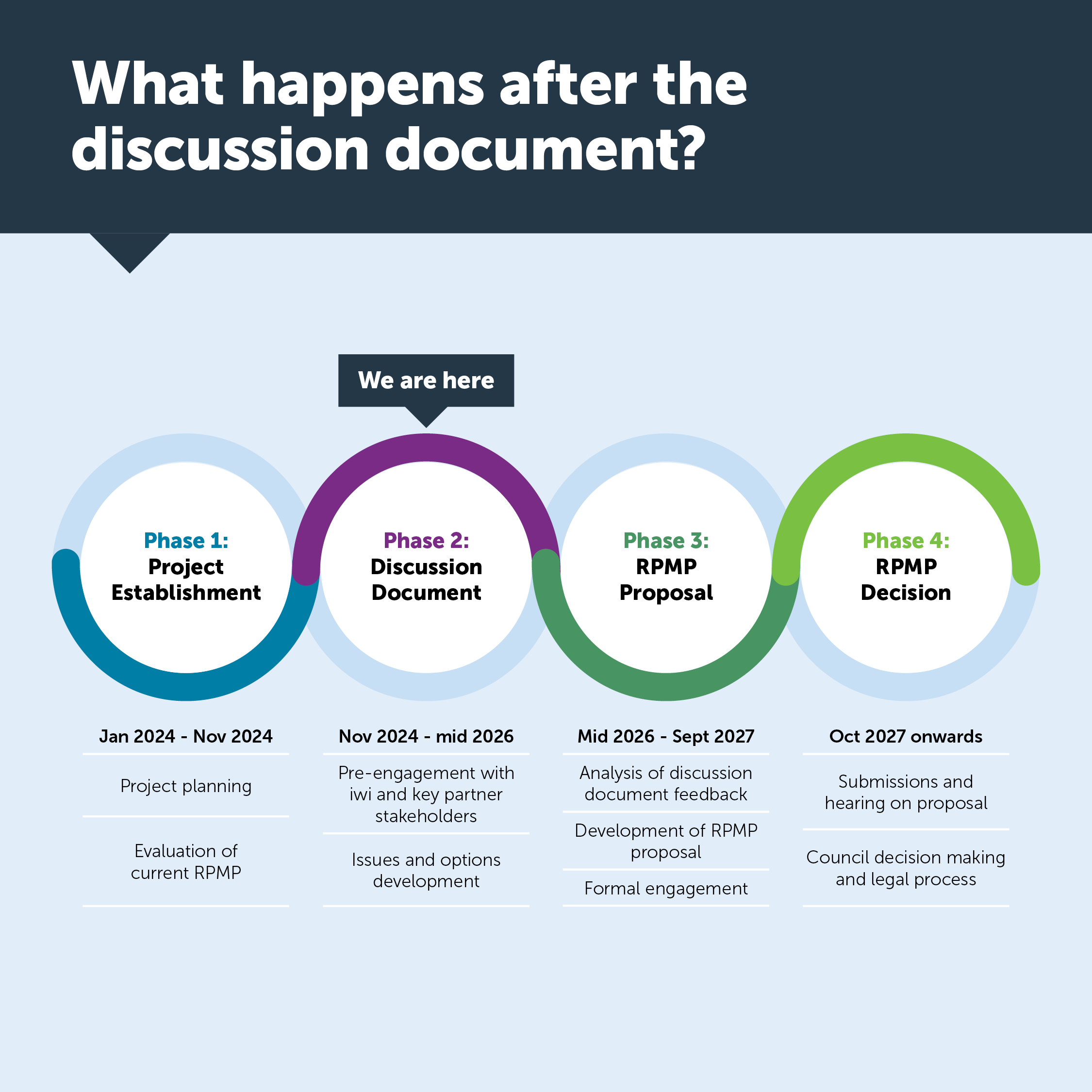
Click/tap the image to zoom in.