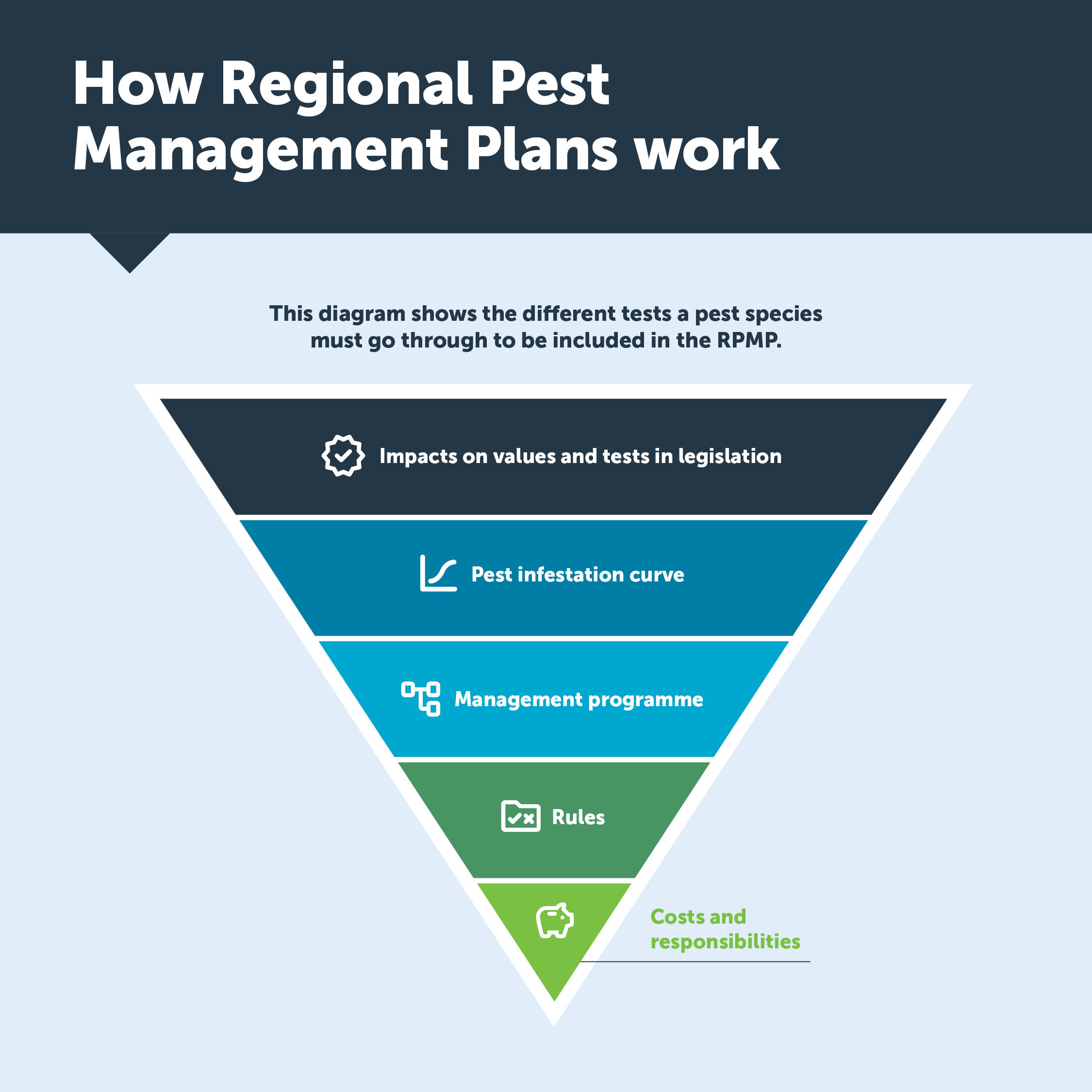
However, a species can only be included in the RPMP as a pest if it meets specific legal tests. And we can only call it a pest if it is in our plan.
These legal tests include that it must be capable of causing real harm in the region, the RPMP must be more effective than relying on voluntary action, and the benefits of managing it through the plan must be greater than the costs. Species that don’t meet these tests can still be managed in other ways. This is discussed in the section on What happens when a species can’t be included in the plan?
Click/tap the image to zoom in.
The Biosecurity Act sets strict criteria for deciding whether a species can be included in the Regional Pest Management Plan.
A species can only be added if it can cause harm in our region (now or in the future) to at least one of the following values set out in the Biosecurity Act:
- Economic wellbeing.
- The viability of threatened species of organisms.
- The survival and distribution of indigenous plants or animals.
- The sustainability of natural and developed ecosystems, ecological processes, and biological diversity.
- Soil resources.
- Water quality.
- Human health.
- Social and cultural wellbeing.
- The enjoyment of the recreational value of the natural environment.
- The relationship between Māori, their culture, and their traditions and their ancestral lands, waters, sites, wāhi tapu, and taonga.
- Animal welfare.
In addition, Council must be confident that including the species in the plan is the right approach. This means they must be satisfied that:
- The plan is an effective way to manage the species.
- The benefits of including the species outweigh the costs.
- The approach is consistent with legislation and other plans.
- There is an effective control tool available for each species.
- The plan is funded by those who either benefit overall or are contributing to the problem being addressed.
- There is likely to be enough funding to implement the plan for at least the next five years.
The RPMP is a regulatory tool under the Biosecurity Act. It can set rules for specific pests and set rules for most landowners/ occupiers, but it can’t solve every biosecurity issue on its own. Some nuisance species can’t legally be included as pests in the RPMP, and some outcomes rely on coordinated action.
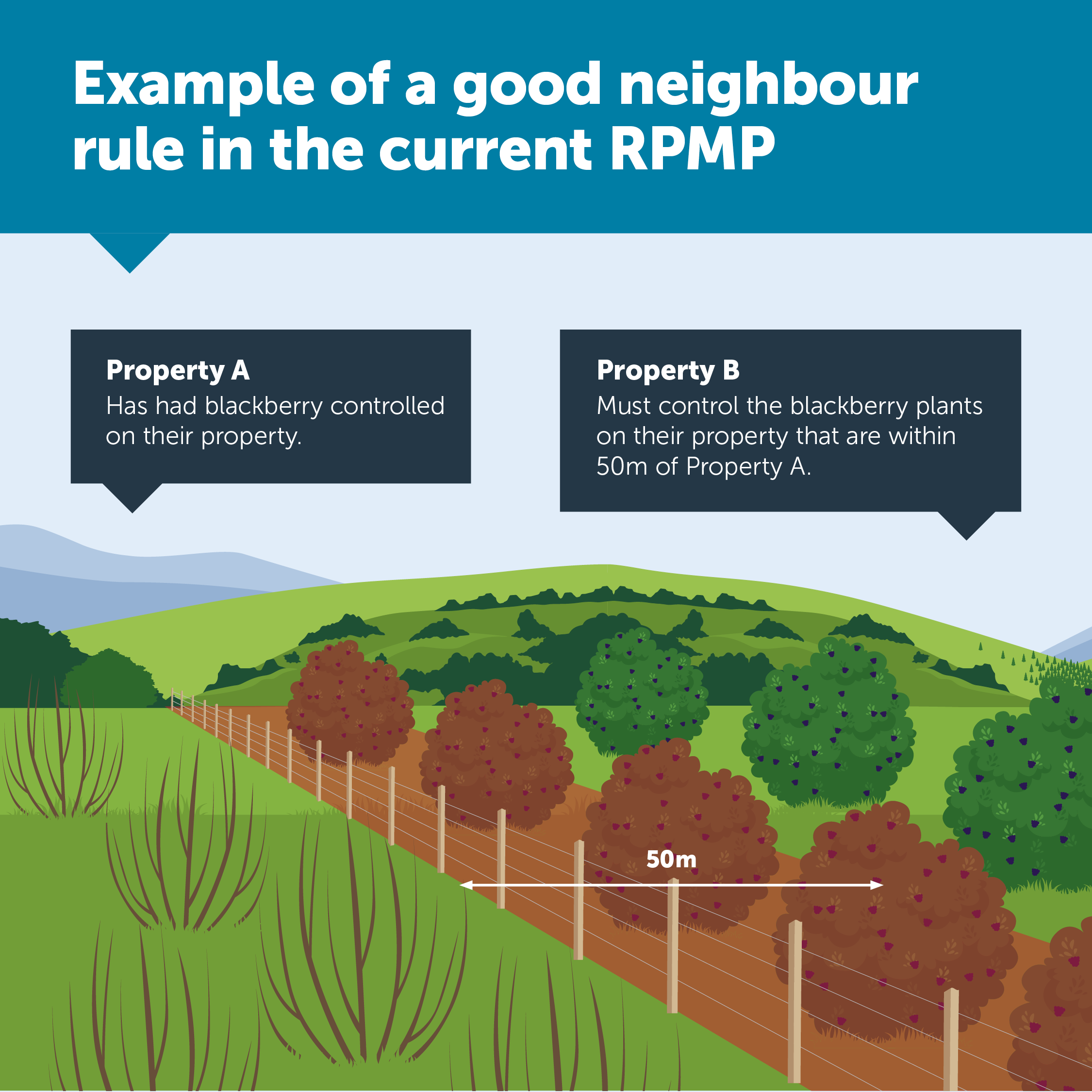
The National Policy Direction on Pest Management (NPD) allows Horizons to include “good neighbour rules” in limited situations. These rules require a landowner to manage a pest if it would otherwise spread to nearby land and cause unreasonable costs for neighbours who are already doing their part to control it.
Good neighbour rules are the only way the RPMP can require the Crown to take action. This means Horizons can only require control on the boundary of Crown land.
Our region consists of more than 2.2 million hectares. Over 1.7 million hectares of this is made up of private land, around 400,000 hectares of this is Crown land, and just over 90,000 hectares is waterbodies, transport corridors, and other unclassified land. Crown land, where we cannot require control other than on the boundary, makes up a significant portion of the region.
Horizons generally focuses pest management work on rateable land so that the people who pay for pest management are the ones who receive the benefits of that work.
Why have a Regional Pest Management Plan?
Horizons is required to review the plan, but we are not required to have one.
Pest control could be carried out voluntarily by occupiers and community groups, or on an opt-in basis by Horizons officers, still funded through rates. However, a formal RPMP enables a clear and coordinated approach across the region, with rules and expectations that guide where and how pests are managed and funded through general and targeted rates as appropriate.
Many aspects of the current plan are working effectively. We have seen that when control is carried out consistently, it works well, but its effectiveness can be reduced if some properties do not act.
We believe having a RPMP is the most effective way to protect the things our region values while making the best use of regional resources.
How can the RPMP work in practice?
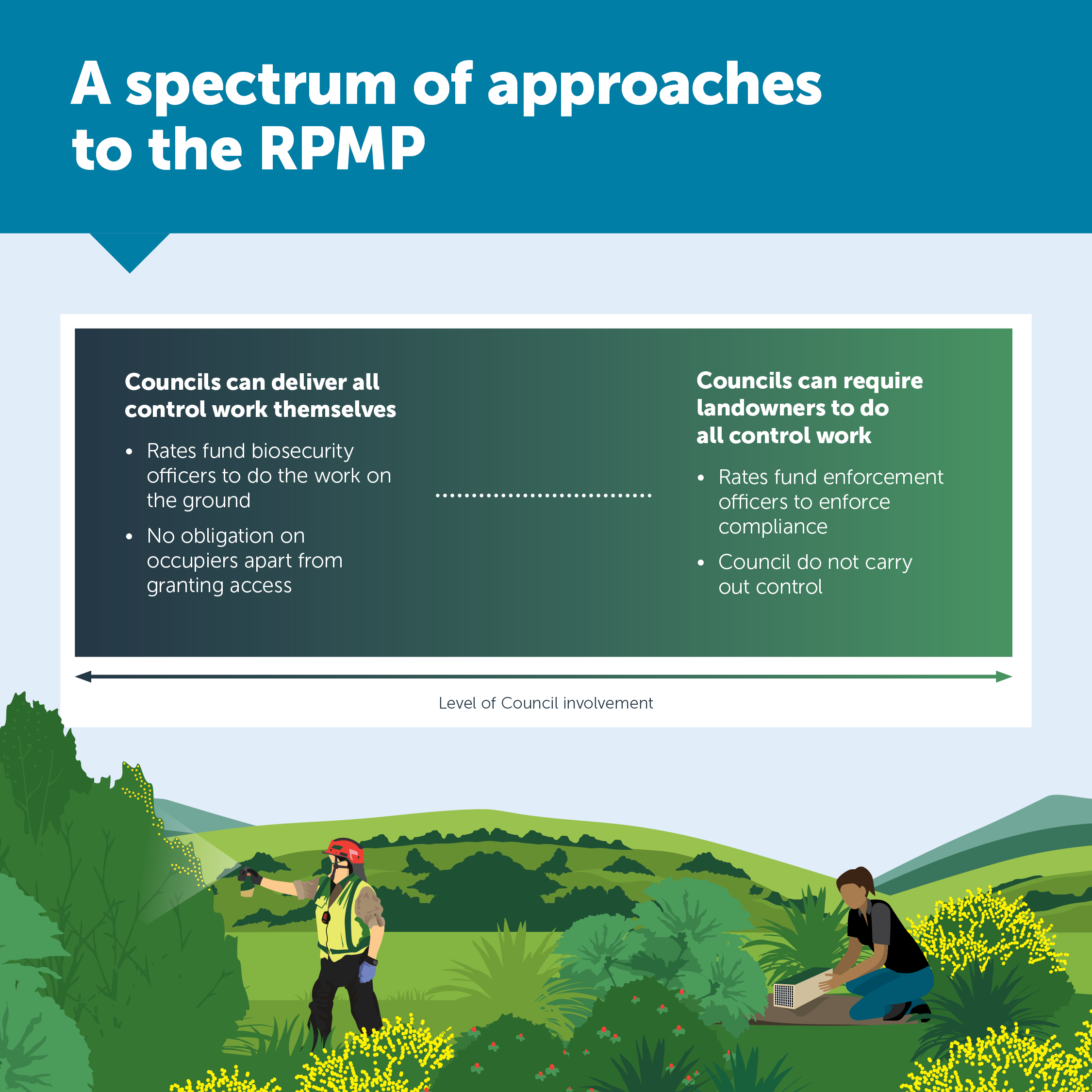
There is a spectrum of approaches to implementing pest management under a Regional Pest Management Plan.
Some species require landscape scale control to be effective, others can be managed on a site-by-site basis, and some require certain control tools. There are species, such as rooks, where using other control methods could be detrimental to controlling the pest.
Click/tap the image to zoom in.
Horizons sits towards the left of the spectrum. Our officers carry out control for exclusion and eradication species, and for progressive containment mapped species within active management zones, where it makes the most sense and budgets allow.
Outside these areas, including for sustained control species, occupiers are responsible for control. The progressive containment programmes include some boundary rules enforceable under the plan on a complaints basis. This approach allows staff to focus on species that pose the greatest risk and are not yet widespread. We believe this model provides the most direct value for ratepayers, delivering control on the ground while still relying on occupiers to alert us to issues and carry out some control work.
Enforcement is currently used selectively as it can be time consuming and has a cost to ratepayers. In general, we see officer time as more effectively spent rather than issuing notices. We are seeking feedback on whether this balance between council-led work and occupier responsibility is appropriate.